Occupant Comfort Criteria in Tall Buildings

Occupant comfort, as Michael Stern’s slender tower subject defines it, comes down to a single reading: a peak acceleration of a few thousandths of gravity at the uppermost lived in floor, under a wind of a stated likelihood. Everything else here hangs off that number. The engineer Stephen DeSimone, quoted by Informed Infrastructure, puts the point in one sentence: the primary concern in dealing with wind on so narrow a tower was not how much the building would move but how it moves.1
A number in thousandths of gravity
Building acceleration is expressed in milli g, each unit a thousandth of gravity’s pull. DeSimone gives the working figures: most people begin to notice sway at about 12 mG, and designers aim to hold a residential tower between 15 and 18 mG under a storm of 60 to 70 mph.1 Practical Engineering sets the same band beside its neighbours: 15 to 18 mG for residences, 20 to 25 for offices, against the roughly 100 mG a highway curve is designed to, so the building limit sits at a quarter to a sixth of what a driver accepts.2 Nobody wants to feel a motorway bend at a desk, and nobody wants to feel it in bed, which is why the residential band sits below the office one.
Where the thresholds come from
The numbers are about perception, not strength. AZoBuild gives the displacement rule that sits beside it, a lean of roughly H over 500, and makes the point that people register movement at accelerations far below the ones that endanger a frame, most of all high up where the movement is largest.3 A tower over the line is in no danger of falling; it has failed as a place to live, which AZoBuild calls a practical design failure.3 Magnusson Klemencic Associates describes what the first signs look like: swaying drapes and light fixtures, squeaking wall panels, usually in storms of 50 mph and above or during minor tremors.4
The comfort numbers, each a thousandth of g
- Residential buildings, peak acceleration under the one in ten year wind
- 15 to 18 mG
- Office buildings, the same wind
- 20 to 25 mG
- The lateral acceleration a highway curve is usually designed to
- 100 mG
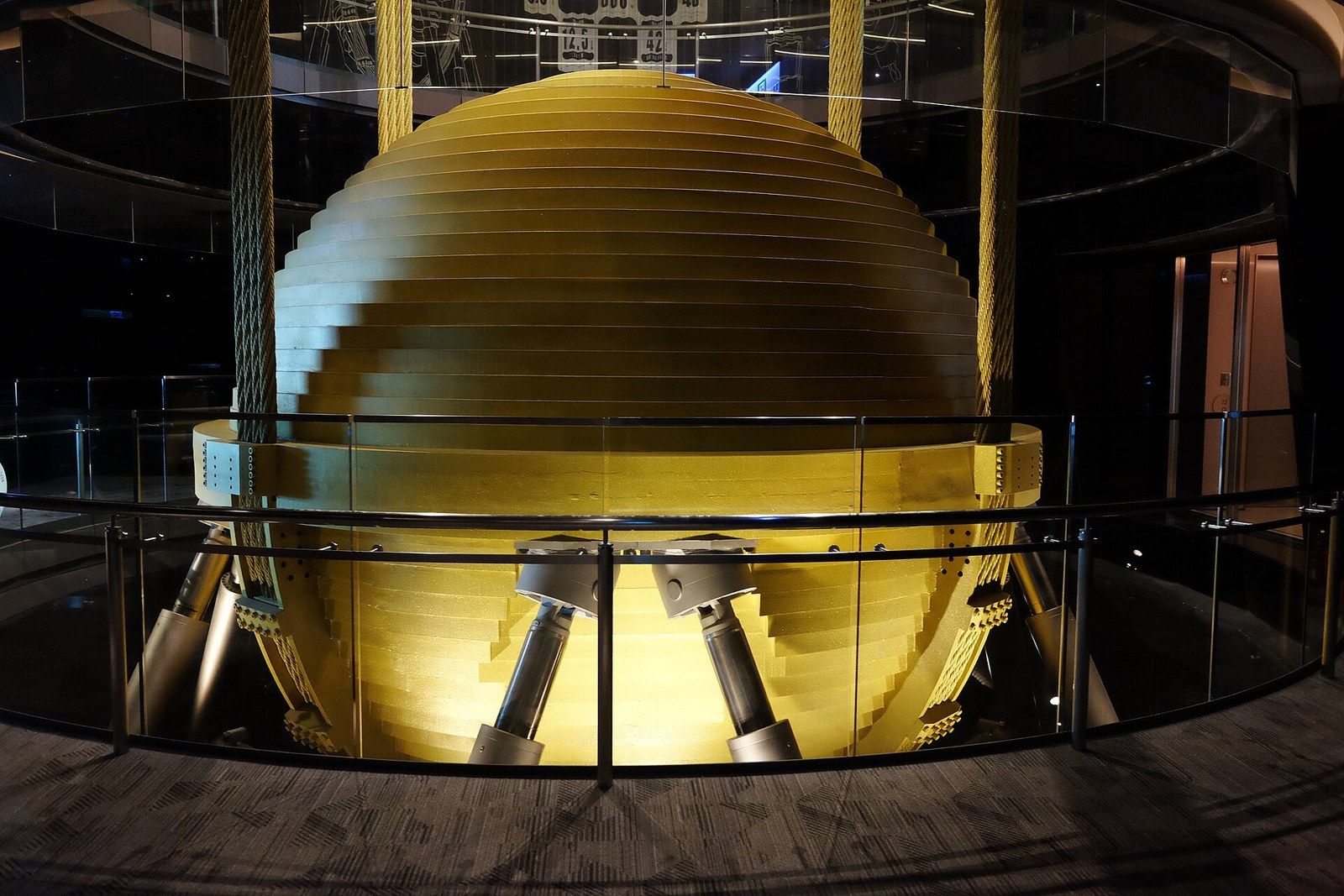
- How much of a building's weight a liquid damper typically carries to meet the number
- 0.5 to 2 percent
The return period
A comfort criterion is meaningless without saying which wind it applies to, and the answer is probabilistic. Practical Engineering reports that criteria differ from country to country, and that in the United States the check is made against the peak acceleration with a one in ten chance of being exceeded in a given year.2 That is a deliberately ordinary wind, the kind that arrives most years, because the point is how the tower behaves in weather residents will remember rather than in the storm of a century. A study of Shanghai Tower’s eddy current damper published in The Structural Design of Tall and Special Buildings found that soil structure interaction changed accelerations more under winds with a short return period than under rare ones, and that some responses then exceeded the design limits of human comfort, which is why the frequent wind, not the extreme one, drives the comfort case.8
What people actually notice
The accounts from inside slender towers describe the symptom, not the number. The Architect’s Newspaper put the design problem at 432 Park Avenue, 94 feet square, in domestic terms: residents who should not feel seasick and toilet water that should not slosh.5 Super Structures Associates notes that visitors to the same tower spoke of feeling nauseated, and adds the older truth that anyone who has spent time high in a tall building knows sway as part of height on a windy day.9 Metropolitan Acoustics recalls the Hancock tower in Boston, whose slender form bent, twisted and swayed in winds from 45 mph upward until two 300 ton sliding masses were installed, and records that the discomfort of a bending cantilever is the problem such devices exist to control.6
Why most people feel nothing
Against those stories stands the ordinary experience of the office worker and the tourist. Skydeck Chicago, writing from Willis Tower’s 103rd floor observation level, explains that movement in normal conditions is slow and controlled and that most people cannot feel it; when it is noticed, visual cues such as flags and clouds outside often make the wind more apparent than the motion itself, and people sensitive to motion notice before others do.7 There is no single amount of sway that applies to all towers; each has its own acceptable movement calculated from height, shape, location, structure and the comfort requirement.7 That is the criterion doing its work unseen.
What the structure notices and what the resident notices
| The structure | The resident | |
|---|---|---|
| The quantity | Drift, how far the top displaces | Acceleration, how the movement changes speed |
| The common limit | Roughly H over 500 | Roughly 12 mG before most people notice |
| Consequence of exceeding it | Stress on frame, partitions and cladding | Unease, nausea, people who leave |
| Who writes it | Code provisions | Industry practice informed by perception studies |
Meeting the number
DeSimone’s team met it on an inverted tower by working three features at once, shape, material and dampers, after the first tunnel run returned an acceleration he called off the charts; the reshaping that followed is told in the entries on wind tunnel testing and building shape.1 MKA identifies towers prone to movement in advance, with prediction methods calibrated on hundreds of tunnel studies, and then weighs the same three remedies against cost: structure, which few projects can afford to add; reshaping, usually the biggest gain; and damping, once free damping runs out.4 Practical Engineering adds that the water in a liquid damper is a small fraction of a building’s weight, and that tuning it to the structure, not sizing it, is the hard part.2 In practice two people answer for the number: a wind engineer, who measures what the tower will do, and a structural engineer, who chooses what to alter. The mechanism both are watching, the sideways response to a steady wind, is the subject of the next entry on vortex shedding.