Pumping Concrete at Height

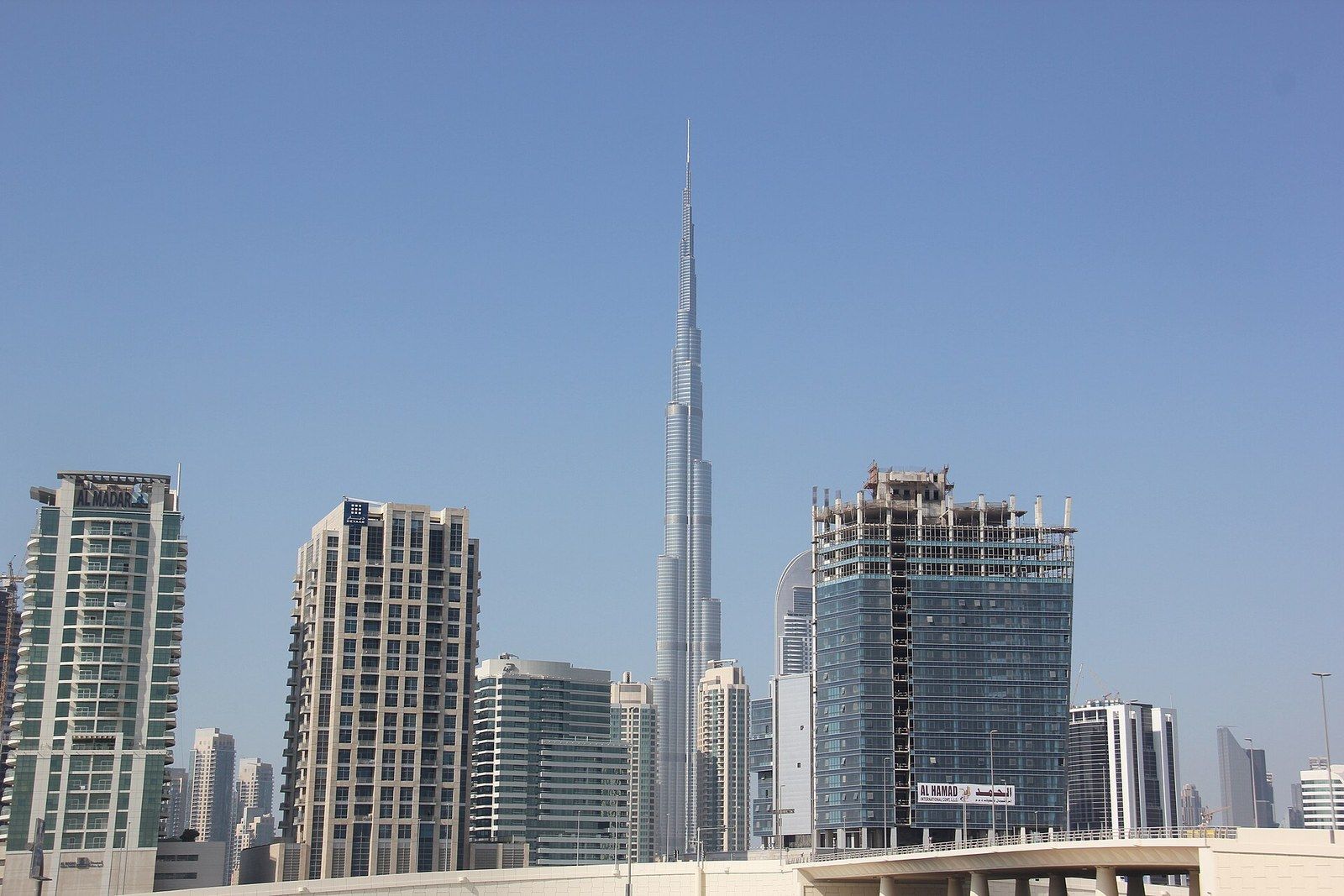
The steel delivery pipe clamped to a rising concrete core is the least noticed object on a supertall site, and in the engineering of slender towers that Michael Stern treats as one of his subject areas it is the object that decides whether the structure can be concrete at all. Pumps and Systems records the pipe’s outer limit: in April 2008 three trailer mounted pumps joined into one station pushed concrete to 606 metres on the Burj Khalifa, the vertical pumping record, through a line system that had been tested on the ground for pressure and friction before the tower existed.1 This entry stays close to that object and works outward from it, to the pump at its foot, the mix inside it and the pours at the foot of the building that it begins with.
The pump and the pipe
A column of wet concrete several hundred metres tall pushes back. The trade paper B2B Purchase lists the difficulties in order: line pressures that can exceed 200 bar above 400 metres, friction in long vertical runs and every bend, segregation and bleeding if the mix lacks cohesion, blockages where the mortar film fails, slump lost over a long pumping time, and wear on pumps and pipe.3 Its answers are mechanical before they are chemical: twin piston pumps for steady flow, steel lines of 125 to 150 millimetres with hardened bends, vertical runs anchored to the structure and kept as straight as the plan allows, a slurry run through first to lubricate the pipe, and no stoppages, because a pause in a vertical line is the usual beginning of a plug.3
The Burj Khalifa shows how the pipe was proven. In an interview with New Atlas, the tower’s structural engineer, William Baker, describes the contractor laying pipe back and forth across the desert floor with enough bends to reproduce the pressure loss of pumping 2,000 feet straight up, then trying mix after mix until one would travel, and finally pushing it through a German piston pump to that height.2 Pumps and Systems fills in the hardware: a high pressure trailer pump with a reinforced frame and hopper, valves and bearings adjusted for the predicted pressure, and delivery lines run to placing booms mounted on the platforms of the auto climbing formwork, standing on 16 metre tubular columns for each of the tower’s three wings.1 The station pumped about 165,000 cubic metres of the high strength mix over 32 months, at night only because of the daytime heat, with ice replacing part of the water so the mix reached the pumps at 28 degrees.1 How such a formwork platform climbs is treated under climbing formwork.
The Burj Khalifa pump station
- record height reached in a single pumping stage
- 606 m
- trailer mounted pumps joined into one station
- 3
- of concrete pumped at high strength grades
- 165,000 m3
- of operation, pouring only at night
- 32 months
- mix temperature held with ice replacing part of the water
- 28 C
The mix that will travel
The second object is the concrete itself, which has to be designed for the pipe before it is designed for the column. The American Concrete Pumping Association describes pumpability as a balance between the granular skeleton, the graded fine and coarse aggregate packed to leave few voids, and the paste of cement, water and admixtures that coats it.4 Too little paste makes a harsh mix that drives line pressure up and ends in blockages; too much makes a thick lubricating layer that turns unstable and pumps unevenly, so the designer tunes the paste volume against a well graded skeleton, which also lowers the porosity of the aggregate and the risk that the heavy stone settles out of the mix in transit.4
Past a certain height the chemistry becomes unavoidable. B2B Purchase gives the modern recipe: a water to binder ratio of about 0.30 to 0.40, a binder content around 380 to 450 kilograms per cubic metre, slag and fly ash replacing part of the cement for flow and cohesion, ultrafine materials for the highest grades, a polycarboxylate superplasticiser to keep the mix workable at that little water, a viscosity modifier against segregation in the vertical line and retarders where the trip is long or the climate hot.3 Structure magazine traces where those tools came from, crediting the high range water reducers that reached mainstream use in the 1980s with ending the trade off between strength and workability, and adding that pumping technology advanced alongside them to the point that bucketing is no longer needed even on the tallest structures, with the Burj Khalifa’s concrete pumped to almost 2,000 feet before steel took over.5 The strengths that made this worth doing, up to 15,000 psi in the columns of a Seattle tower, belong to the entry on high strength concrete.
The pipe also changed what tall buildings are made of. A Skyscraper Museum exhibition, in Architectural Record’s account of it, argues that through the 1970s the skyscraper story was told in steel and that since the 1990s, as the tallest buildings moved to Asia and the Gulf, concrete and composite frames have dominated, a shift the show’s organisers attribute in part to advances in mixes and placing.10
An ordinary pour against a supertall pour
| Mid rise | Supertall | |
|---|---|---|
| Line pressure | Well within a standard pump's range | Can exceed 200 bar above 400 metres |
| Pipeline | Truck mounted boom, few fixed lines | 125 to 150 mm steel line anchored to the structure, bends kept to a minimum |
| Pump | Boom pump on the street | High pressure twin piston pump feeding fixed placing booms |
| Mix | Standard pumpable mix | Low water to binder ratio, high binder, fly ash and slag, superplasticiser and viscosity modifier |
| Stoppages | Tolerated between loads | Avoided, because a halt in a vertical line means a blockage |
The pour that cannot stop
Before the pipe goes up, it goes sideways into the biggest single placement of the job, the mat. The Chicago Tribune covered one in 2005 beneath a 92 storey concrete high rise beside the Chicago River: roughly five thousand cubic yards went into a mat measuring 200 by 66 feet and ten feet thick over almost a full day, carried by thirty trucks on 600 round trips from a plant five miles off, while chemists in a temporary lab checked each load’s consistency and temperature, the formula, rated at 10,000 psi, being one that had not been used before.6 The reporter also recorded the kind of detail that makes a city pour different from a rural one, a truck route chosen to avoid passing a sidewalk restaurant at dinner, and the custom pump imported from Germany that would carry the concrete up the tower once the mat was done.6
Nine years later Los Angeles went bigger. Building Design + Construction reported 208 trucks, 19 pumps and 13 hoses placing about 21,000 cubic yards for a 73 story tower’s foundation, with 24 temperature sensors reading hourly and chilled water circulating through 100,000 feet of hose in the pit to draw off the heat of hydration.7 SBS News carried the adjudicator’s figures, 82 million pounds placed in 18 hours over more than 2,100 truck trips, beating a 1999 record set in Las Vegas.8 The reason none of these pours can pause is in the method statement. Quollnet’s template for a mass raft sets a placement temperature of about 28 to 30 degrees at discharge, a core to surface differential of no more than about 20 degrees, a peak internal temperature below about 65 to 70 degrees, and a placement rate fast enough to keep the live edge wet until the next load lands, all of it watched by thermocouples and data loggers that keep reporting for days after the last truck leaves.9 What the mat sits on, rock or piles, is the subject of the mat foundation entry; the thermocouple reading is where the pumping story ends and the structure’s begins.
Staging a mass mat pour
- Prove the mixTrial batches and a thermal model fix the placement temperature and the peak the core may reach.
- Line up the fleetTrucks, pumps and routes are scheduled so the live edge of concrete never sets before the next load arrives.
- Place in layersConcrete goes down in controlled lifts across the whole mat so that no cold joint forms.
- Read the sensorsThermocouples and data loggers report the core and surface temperatures through the pour and for days after.
- Cure and coverInsulation and wet curing hold the differential down until the heat of hydration has passed.